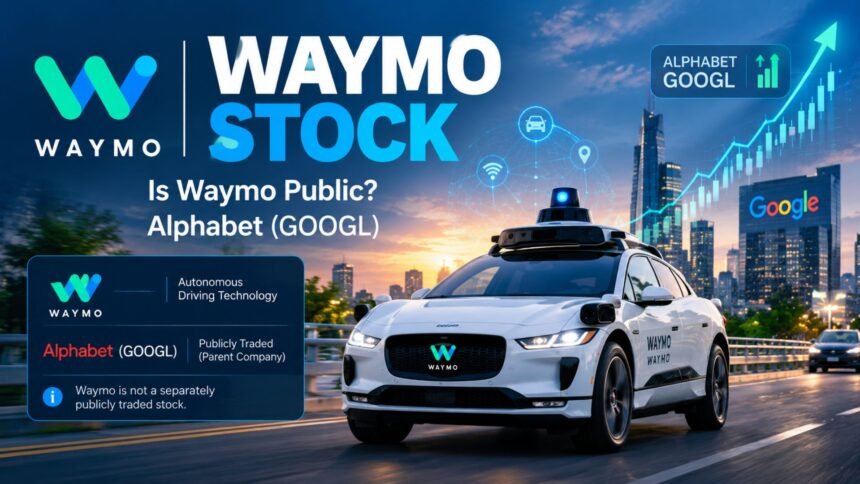
Waymo stock attracts attention because autonomous driving has moved beyond laboratory testing into commercial ride-hailing. But there is an important distinction for investors: Waymo stock is not currently available as a standalone publicly traded security. Waymo is an Alphabet-owned autonomous-driving company, so investors looking for public-market exposure generally need to examine Alphabet rather than search for a separate Waymo ticker.
That distinction matters because Waymo’s business is expanding rapidly while its ownership structure remains private. In February 2026, Waymo announced a $16 billion investment round that valued the company at $126 billion after the financing.
Is Waymo Stock Publicly Traded?
No. As of September 2026, Waymo does not have its own publicly listed shares or an independent stock ticker.
Waymo operates as a subsidiary of Alphabet, the parent company of Google. Alphabet remains Waymo’s majority investor and participated in the company’s earlier financing rounds.
This means investors cannot currently open a brokerage account and purchase shares specifically representing Waymo. Buying Alphabet shares provides exposure to Alphabet’s overall business, which includes Google Search, YouTube, cloud services, advertising, artificial intelligence initiatives, and other businesses—not Waymo alone.
For anyone researching Waymo stock, understanding this corporate structure is the first step.
Waymo’s $126 Billion Valuation
Waymo’s private valuation became a major talking point in 2026. The company raised $16 billion in new capital at a post-money valuation of $126 billion, according to Waymo’s announcement. The round included investors such as Dragoneer Investment Group, DST Global, Sequoia Capital, Andreessen Horowitz, Mubadala Capital, Bessemer Venture Partners, Silver Lake, and T. Rowe Price.
The valuation was substantially higher than Waymo’s $45 billion valuation from its previous major financing round in 2024, according to Reuters.
A private valuation, however, is not the same thing as a public stock market capitalization. Private funding rounds establish prices at which selected investors purchase shares, while public-market prices change continuously based on trading activity.
That difference is particularly relevant when people search for Waymo stock price or try to estimate what a future Waymo share price might look like.
Waymo’s Business Is Scaling
Waymo’s investment case is closely connected to the growth of autonomous ride-hailing.
The company reported that it provided 15 million rides during 2025, more than triple its annual volume from the previous year. By early 2026, Waymo said it was providing more than 400,000 rides per week across six major U.S. metropolitan areas.
Its commercial footprint has continued expanding. In September 2026, Waymo announced public rider operations in Denver, San Diego, and Tampa, bringing its service to 14 cities according to the company.
Waymo is also pursuing international expansion. The company announced plans for a commercial autonomous ride-hailing service in Tokyo in 2027 and Singapore in 2028. It has also announced plans to prepare for commercial operations in Munich toward the end of 2027.
These developments are significant because autonomous driving requires more than a working vehicle. Companies need mapping, fleet operations, software, vehicle partnerships, regulatory approvals, customer demand, and the ability to operate reliably across different environments.
| Factor | Waymo’s Position in 2026 |
|---|---|
| Public stock ticker | None as a standalone company |
| Parent company | Alphabet |
| Latest announced funding | $16 billion |
| Post-money valuation | $126 billion |
| 2025 rides | 15 million |
| International expansion | Tokyo, Singapore and Munich plans |
| Core business | Fully autonomous ride-hailing |
What Could Drive Future Value?
Several factors could influence Waymo’s future valuation and the eventual market interest surrounding Waymo stock if the company eventually becomes publicly traded.
Commercial expansion
More operating cities could increase the number of potential riders and improve utilization of Waymo’s autonomous fleet. The company is expanding across the United States while preparing for international markets.
Autonomous driving technology
Waymo’s technology is based on its Waymo Driver autonomous-driving system. The company reported that its latest safety analysis covered more than 220 million fully autonomous miles through March 2026. It said its vehicles experienced 94% fewer crashes causing serious or fatal injuries compared with human drivers in the same areas and period. These figures are Waymo’s analysis and should be interpreted in that context.
Partnerships
Autonomous mobility depends on relationships with automakers, transportation companies, regulators, and local operators. Waymo’s Tokyo expansion, for example, involves Japanese taxi company Nihon Kotsu and mobility platform GO.
Market economics
Technology alone does not guarantee a profitable robotaxi business. Investors will eventually need to examine revenue per ride, fleet costs, maintenance, insurance, vehicle utilization, operating expenses, and the cost of expanding into new markets.
💡 Pro Tip:
When evaluating private autonomous-driving companies, separate technological progress from financial performance. A growing ride count can demonstrate demand, but sustainable economics require the business to generate attractive revenue relative to vehicle, technology, insurance, maintenance, and operating costs.
What Are the Risks?
The future of Waymo stock would depend on more than Waymo’s technological achievements.
Competition is one major consideration. Tesla, Amazon’s Zoox, Wayve, and other autonomous-driving companies are developing competing approaches. Reuters has described growing competition in robotaxis as Waymo expands internationally.
Regulation is another variable. Autonomous vehicles operate under transportation and safety rules that can differ between states and countries. Expansion therefore depends partly on regulatory approval and local operating conditions.
There is also execution risk. Moving from a successful service in selected cities to a much larger international network requires substantial capital and operational coordination.
Finally, valuation risk deserves attention. A high private valuation can reflect strong expectations for future growth. If commercial adoption or profitability develops more slowly than expected, future financing terms could change.
How Can Investors Get Exposure Today?
People searching for Waymo stock ticker should first understand that there is no standalone Waymo ticker to purchase.
Alphabet is the publicly traded parent company with an ownership stake in Waymo. However, purchasing Alphabet shares should not be treated as equivalent to buying Waymo because Alphabet’s financial results reflect many businesses and investments beyond autonomous vehicles.
Investors researching Alphabet can therefore consider Waymo as one component of the broader company’s long-term technology portfolio rather than as a separately traded business.
If Waymo eventually conducts an initial public offering, the situation would change. A future IPO could establish a public ticker, offering investors direct exposure to the company. However, an IPO date, valuation, share structure, and ticker cannot be assumed until officially announced.
📌 Key Takeaway:
Waymo is currently a privately held Alphabet subsidiary rather than an independently traded public company. Its $126 billion post-money valuation, expanding robotaxi operations, and international plans make it a closely watched autonomous-driving business, but there is no standalone Waymo share price or ticker to buy today.
Frequently Asked Questions
Does Waymo have a stock ticker?
No. Waymo does not currently have a standalone public stock ticker. The company is part of Alphabet, which remains its majority investor. Therefore, investors cannot currently purchase Waymo shares directly through a public stock exchange.
Can you buy Waymo stock?
There is currently no publicly traded Waymo stock available to ordinary stock-market investors. Waymo has raised private capital from Alphabet and other institutional investors, but those private financing transactions are different from buying shares on a public exchange.
What is Waymo’s valuation?
Waymo announced a $16 billion financing round in February 2026 at a post-money valuation of $126 billion. Reuters reported that this was substantially above the company’s $45 billion valuation from its 2024 financing.
Is Waymo owned by Google?
Waymo is owned within Alphabet, Google’s parent company. Alphabet is Waymo’s majority investor. Waymo began as a Google project before becoming a separate Alphabet company focused on autonomous-driving technology and services.
Will Waymo have an IPO?
There is no officially announced Waymo IPO date that should be treated as confirmed. Investors should rely on company announcements and regulatory filings for any future listing information rather than assuming that a private valuation automatically means an IPO is imminent.
Conclusion
For anyone researching Waymo stock, the key fact is simple: Waymo is not independently listed on a public stock exchange as of September 2026. Its rapid expansion, $126 billion private valuation, growing autonomous ride-hailing operation, and international plans have nevertheless made the company an important name in the self-driving industry.
For now, public-market exposure comes indirectly through Alphabet rather than a dedicated Waymo ticker. If Waymo eventually becomes a publicly traded company, investors will then have a clearer opportunity to evaluate its standalone financial results, valuation, growth prospects, and risks.